Your gift supports science, arts, and education
Your card details are entered on this page, secured by Stripe.
We're sorry - we can't take your gift through the website right now. Please try again in a few minutes.
If it keeps happening, email admin@samuellawrencefoundation.org and we'll take your gift directly.
Search our knowledge base for answers about nuclear waste, our programs, volunteering, and more.
29 articles found
Comprehensive collection of website resources and reference materials compiled by SLF.
Report arguing that NY's plan for up to 3.3 GW of new nuclear reactors will sharply raise ratepayer costs, using Georgia's Plant Vogtle as key comparison.
SLF's joint advocacy letter to the San Diego County Board of Supervisors opposing the inclusion of nuclear waste "reprocessing" (marketed as "recycling") as a feasible solution for the waste at San Onofre.
The first of three studies exploring the link between cancer and nuclear plant proximity from the Harvard T.H. Chan School of Public Health, focused on Massachusetts.
Understand the economic implications of a new "nuclear renaissance" driven by Small Modular Reactors (SMRs), Generation IV designs, new large reactors, and life-extension of existing plants.
Harvard-led study that links cancer and childhood exposure to radiation exposure from the former Manhattan Project-era uranium waste storage site in Coldwater Creek, MO.
Use our advocacy toolkit to contact your local, state, and federal representatives about nuclear waste safety. We provide template letters, key talking points, and contact information for elected officials in the San Onofre region.
We track and publish summaries of Nuclear Regulatory Commission inspection reports for San Onofre. Recent inspections have noted scratched fuel canisters during loading operations and concerns about long-term corrosion in the marine environment.
Navigate to the My Requests page from your member dashboard. Click "New Request" and fill in the subject, description, and category. Our team will review and respond within 2 business days. You can track the status of all your requests from the same page.
Stay up to date with our community events including town halls, webinars, beach cleanups, and advocacy days. We host regular public forums where residents can learn about nuclear waste issues and engage with policymakers and industry experts.
Explore our curated collection of resources on the transition to clean energy, including research papers, policy briefs, and educational materials about renewable alternatives to nuclear power, grid modernization, and energy storage technologies.
Consent-Based Siting is an approach where communities voluntarily agree to host a nuclear waste storage or disposal facility. The Department of Energy has been exploring this approach, and the Foundation advocates for its proper implementation to relocate waste from coastal sites like San Onofre.
Intern research paper arguing that global nuclear waste mismanagement constitutes "nuclear colonization" — marginalized communities disproportionately bear environmental and health risks.
Holtec UMAX canisters are 5/8-inch thick stainless steel containers used to store spent nuclear fuel at SONGS. Unlike thick-walled casks used internationally, these canisters have no inner liner, cannot be monitored internally, and are vulnerable to chloride-induced stress corrosion cracking from th
You can volunteer by joining one of our community outreach programs, attending public forums, or helping with our annual clean energy events. Visit the Get Involved section of our website or contact us directly to learn about current opportunities.
The Foundation advocates for the safe relocation of nuclear waste away from the coast, pushes for upgraded thick-walled cask storage, and educates the public and policymakers about the risks. We fund independent research and host community forums.
The waste is stored in an earthquake and tsunami zone, adjacent to 8.4 million residents within a 50-mile radius. The thin-walled Holtec canisters cannot be inspected for cracks, repaired, or monitored from the inside, creating long-term safety and environmental risks.
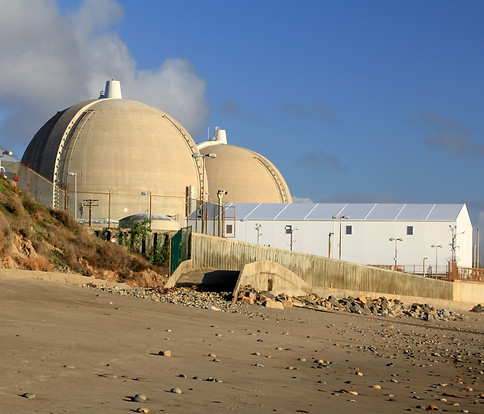
The San Onofre Nuclear Generating Station (SONGS) is a decommissioned nuclear power plant located on the coast of San Diego County, California. It operated from 1968 to 2013 and is currently storing 3.6 million pounds of nuclear waste on-site in thin-walled canisters just 100 feet from the ocean.
Membership is free and open to everyone. Simply sign up through our website to access member-only resources, receive our newsletter, track your support requests, and stay informed about upcoming events and policy updates.
Proposed by Mike Levin in 2024, this bill would replace DOE's current nuclear waste management structure with a new independent federal agency and establish a consent-based siting process.
Tentative ruling denying SLF's petition challenging the California Coastal Commission's approval of a Coastal Development Permit for the SONGS decommissioning project.
Public opinion survey (n=1,000 registered voters, San Diego and Orange County) finding broad public concern and low trust regarding SONGS radioactive waste storage.
Comprehensive task force report analyzing safety, regulatory, and policy challenges around spent nuclear fuel storage at SONGS. Outlines 29 findings and 30 recommendations across five areas.
This whitepaper models the economic fallout of a radiological release from SONGS' spent fuel storage facility on the three-county Southern California region using IMPLAN economic modeling.
SLF-authored technical report identifying three core risk categories at SONGS' dry-cask spent fuel storage: poor location, poor technology, and poor management.
Backgrounder compiling coalition views on nuclear plant decommissioning risks, methods, waste disposition, funding adequacy, and lack of state/local oversight. Includes dedicated SONGS case study.
Peer-reviewed article arguing that molten salt reactors and sodium-cooled fast reactors will actually worsen waste management challenges due to unusual and highly reactive fuel chemistry.
UCS explainer arguing against reprocessing spent nuclear fuel, contending it fails to solve the waste problem while increasing proliferation and terrorism risks.
Analysis comparing the economics of reprocessing versus direct disposal of spent nuclear fuel from the Belfer Center at Harvard Kennedy School.
Can't find what you're looking for? Our team is here to help.